Free Site Assessment
 02 9629 5200
 Contact Us



 March 10, 2023
 Building a new home on acreage gives you three things a suburban block cannot: room to build the house you actually want, a property whose value rests on land that is not being made any more, and a way of living that the city does not offer at any price. Each of those benefits is real, each comes with conditions attached, and each is worth understanding properly before you commit two years and a large budget to it.
This guide takes the three benefits one at a time, sets out what each looks like in practice on a block near Sydney in 2026, and is honest about what you trade for them. It is the short “why” piece in a set of acreage guides; the “how” lives in the linked articles.
The Three Benefits in Short
- Space to build what you want. Single-storey homes of 270 to 730 square metres, a triple garage and workshop, a shed, a pool, a secondary dwelling for family, and outdoor rooms that face the sun rather than a fence.
- Value that rests on land. Acreage land near Sydney is cheaper per square metre than any suburban block, it does not depreciate the way a building does, and well-located rural residential land is in fixed supply inside a growing city.
- A lifestyle the city cannot sell you. Privacy, quiet, dark skies, animals, a home business, food from the garden, and running costs that a big roof full of solar and rainwater can bring close to zero.
- The conditions. Zoning has to permit a house, bushfire rating shapes the design, services stop at the road, and the approval and build take 16 to 24 months. None of the three benefits arrives without meeting them.
In This Guide
Benefit one: you can build the home you want
On a suburban block the design is shaped by the boundaries. On acreage it is shaped by how you want to live. That difference shows up in every part of the plan.
A larger home, on one level
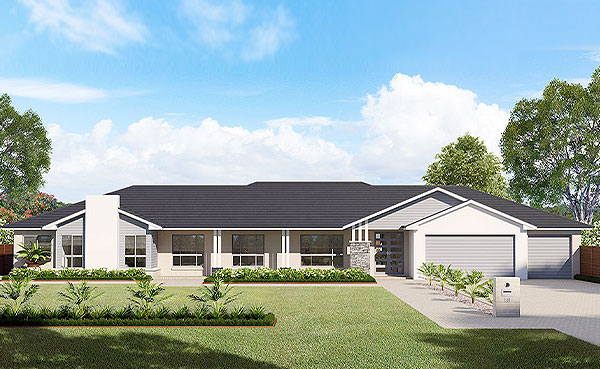
Without a small block forcing the plan upward, acreage homes spread out. The Provincial Homes acreage collection runs from the four-bedroom Braidwood 29 at about 270 square metres to the six-bedroom Berridale 79 at about 735, all single storey, all with two- or three-car garages. A single level suits the land, the bushfire rules, the climate and the way people live on a big block, and it is the home most buyers keep into retirement because there are no stairs to manage later.
Wings instead of floors
A large single-storey plan works when it is zoned: a living wing facing north onto the outdoor room, a master wing with its own outlook, a children’s wing that closes off at night, a guest or grandparents’ suite at the far end, and the garage, workshop and mudroom taking the west side. Privacy that a two-storey suburban home achieves by stacking, an acreage home achieves by spreading.
The buildings a suburban block cannot hold
- Triple garage and workshop for vehicles, the mower, a boat or a trailer, and somewhere to make things.
- A shed. On rural zones and R5 land east of the Great Dividing Range, farm buildings, garden sheds, carports and rainwater tanks can be exempt development within set standards, and larger outbuildings can be approved as complying development under the Rural Housing Code.
- A pool placed for sun and view rather than squeezed against a boundary.
- A secondary dwelling. Under the Housing SEPP a self-contained dwelling of up to 60 square metres is permitted in residential zones including R5, and on lots of 450 square metres or more it can be approved as complying development. In rural zones it depends on the council’s plan. Either way it is a home for parents or adult children with a real degree of independence, not a converted garage.
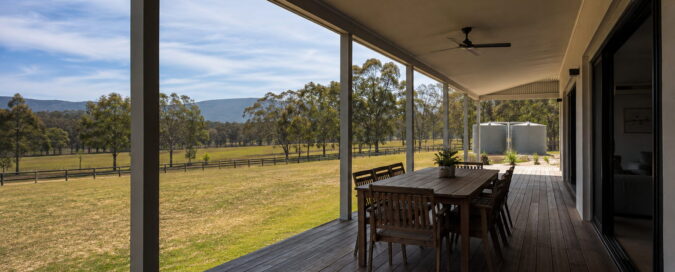
- Outdoor rooms that work. A deep north-facing verandah or alfresco, an outdoor kitchen, a fire pit, a vegetable garden and an orchard, each with room around it.
Orientation you choose
The most valuable design decision on acreage is free. The Australian Government’s Your Home guide puts the ideal for living areas within 15 degrees west and 20 degrees east of solar north; on a suburban block you take what the street gives you, and on acreage you place the house exactly there, with bedrooms to the east and service rooms to the west. That one decision does more for winter warmth, summer comfort and the 7-star BASIX rating every new NSW home now needs than any product you can buy.
Read more: What you need to know about acreage home designs in NSW

Benefit two: value that rests on land
No one can promise what any property will be worth in ten years, and this article will not. What can be said is where the value of an acreage property sits and why that position is a strong one.
The land is the asset
A house depreciates; land does not. On a suburban block the building is a large share of the total value and the land a small one. On acreage the proportions reverse: the block is the larger part of what you own, and the house sits on a small fraction of it. That is the structural reason acreage tends to hold value through the cycles that move house prices, and it is why lenders, for all their caution about lot size, still treat well-located rural residential land as sound security.
Cheaper per square metre than any suburb
Acreage land near Sydney costs a fraction per square metre of what a suburban block costs, even when the total price is higher. You are buying land at a wholesale rate and building on a small part of it, and the rest is yours to use, hold or, where zoning ever allows, do more with.
Fixed supply inside a growing city
Large-lot and rural residential land within commuting distance of Sydney is not being created. Some of it is being rezoned for smaller lots, which reduces the stock of genuine acreage rather than adding to it, and the demand from families, downshifters and multi-generational households moving out of the city is not a passing trend. Scarcity is not a guarantee of growth, but it is the condition under which growth usually happens.
What protects the value you build
- A house proportionate to the area. The most common way to lose money on acreage is to build a home the local market will not pay for. A valuer prices the finished property against comparable sales in the region, not against what it cost.
- Compliance done properly. Bushfire construction to the correct level, an approved wastewater system and a legal dwelling on correctly zoned land are what make the property saleable and insurable. A shortcut on any of them is a discount at resale.
- Durable, low-maintenance materials. A house that still looks right after fifteen years without repainting or recladding sells on its condition.
- The land in good order. Fencing, access, a well-kept Asset Protection Zone and a managed paddock are part of what a buyer of acreage is paying for.
Read more: The ultimate guide to acreage living near Sydney
Benefit three: a lifestyle change
A property on acreage is not just about the house. It is a different way of living, and for most people who make the move it is the reason they made it.
- Privacy and quiet. No neighbour’s wall, no traffic at the window, and the nearest house often out of sight. Dark skies at night and birds in the morning are not marketing lines on acreage; they are the default.
- Room for animals. Horses, chickens, a couple of sheep or alpacas, and dogs that can run. Rural and large-lot zones generally allow keeping animals in ways suburban councils do not, within each council’s rules on numbers and setbacks.
- A home business. A study with its own entry, a workshop or a studio, with the space and the zoning to run a business from home that a suburban block would not accommodate.
- Food from the block. An orchard, a vegetable garden watered from the tanks or the treated wastewater irrigation area, and the time and space to keep them.
- Running costs close to zero. A 400 square metre roof collects about 400 litres for every millimetre of rain and carries a solar array most suburban homes cannot fit. With a battery, heat-pump hot water and induction cooking, an acreage home can generate most of what it uses and keep the lights and pumps on through the outages rural feeders get.
- Family close, not on top of you. A guest wing or a secondary dwelling keeps parents or adult children within a short walk while everyone keeps their own front door.
- Weekends at home. The reason people drive out of the city on a Friday night is usually the thing they now live in.
The trade-offs are covered below, and they are real. But the lifestyle benefit is the one that people who have made the move rarely regret, and it is the one that does not show up on a valuation.
Read more: Building your dream acreage escape near Sydney
What you trade for the three benefits
An honest account of acreage includes the other side of the ledger.
| Benefit | What it costs you | How to manage it |
|---|---|---|
| Space to build what you want | A larger home and the acreage-only costs of driveway, power, tanks, wastewater and bushfire construction, commonly $80,000 to $200,000 on top of the house | Assess the block before you buy or design; get every site cost into a fixed-price contract; keep the house proportionate to the area |
| Value that rests on land | Higher upfront capital, tighter lending on larger blocks, and a valuation that prices the finished home against the region rather than its cost | Confirm the lender’s land-size policy before exchange; get an indicative valuation early; build durable and compliant |
| A lifestyle change | Distance from shops, schools and medical care; maintenance of hectares, fences, tanks and pumps; bushfire risk and the yearly work of the Asset Protection Zone; higher insurance | Choose a block near a town and a station; design the home low-maintenance from the start; place the house to bring the bushfire rating down |
Acreage is not the right move for someone who needs to be in the city five days a week and hates the drive, for a tight budget that cannot absorb the extras, or for anyone who wants a quick approval. For everyone else the trade-offs are manageable, and most of them are managed at the site assessment stage rather than after.
Getting the benefits without the surprises
- Check the block can carry a house. On R5 land a dwelling is permitted; on rural zones it often depends on the council’s minimum lot size or a dwelling entitlement. The Section 10.7 certificate settles it and should be read before exchange.
- Get the bushfire rating early. Most acreage near Sydney is bush fire prone land, a council cannot approve a home on it unless the design complies with Planning for Bush Fire Protection, and where the house sits decides how much the rating costs. A free site assessment covers this and the services position before any design work.
- Design to the land. Solar north, the view, the slope and the Asset Protection Zone resolved together on a site plan before a floor plan is drawn.
- Price the whole project. House at roughly $2,500 to $4,200 per square metre, the acreage extras, reports and approvals, and a contingency of 8 to 12 per cent, on a fixed-price contract with site costs inside it.
- Use a builder who has done it. Acreage brings bushfire construction, on-site wastewater, rainwater systems, long service runs and rural council processes that a suburban-only builder will price and sequence badly.
Read more: Our 10-step process from choosing a home to construction completion
Frequently asked questions
What are the main benefits of building a home on acreage?
Three. Space to build the home you want, which on acreage means a large single-storey plan in wings, a triple garage and workshop, a shed, a pool and often a secondary dwelling, all oriented to the sun rather than a fence. Value that rests on land rather than a depreciating building, bought cheaper per square metre than any suburban block and in fixed supply within reach of Sydney. And a lifestyle the city does not offer: privacy, quiet, animals, a home business, food from the block and running costs a big roof of solar and rainwater can bring close to zero.
How big a home can I build on acreage?
Large. Acreage designs commonly run 270 to 730 square metres on a single level, and the Provincial Homes acreage collection spans the four-bedroom Braidwood 29 to the six-bedroom Berridale 79. The practical limits are the council’s setbacks, height and landscaped area controls, the Asset Protection Zone on bush fire prone land, and the budget, since the house costs roughly the same per square metre as a suburban build and the size is what drives the total.
Can I build a shed or a second dwelling on acreage?
Usually. On rural zones and R5 land east of the Great Dividing Range, farm buildings, garden sheds, carports and rainwater tanks can be exempt development within set standards, and larger outbuildings can be approved as complying development under the Rural Housing Code. A secondary dwelling of up to 60 square metres is permitted in residential zones including R5 under the Housing SEPP and can be complying development on lots of 450 square metres or more; in rural zones it depends on the council’s plan and usually needs a development application. The lot cannot be subdivided to sell the secondary dwelling separately.
Does an acreage home hold its value?
No property comes with a guarantee, but the structure of an acreage property favours it. The land is the larger part of the value and does not depreciate the way a building does, it is bought cheaper per square metre than suburban land, and well-located rural residential land near Sydney is in fixed and shrinking supply. What protects the value you build is a home proportionate to the area, bushfire, wastewater and zoning compliance done properly, durable materials and a block kept in good order.
Can I keep horses or other animals on acreage?
Generally yes. Rural and large-lot residential zones allow keeping animals in ways suburban councils do not, subject to each council’s rules on the number of animals per hectare, setbacks from boundaries and dwellings for stables and yards, and manure and drainage management. Stock holding yards and farm buildings can often be exempt development on rural land. Check the council’s development control plan for the specific zone before committing to a block for a particular animal.
What is the downside of building on acreage?
Higher upfront cost, mainly the acreage-only lines of driveway, power connection, tanks, wastewater and bushfire construction, which commonly add $80,000 to $200,000 to the house; tighter lending on larger blocks; distance from shops, schools and medical care; the maintenance a large block demands; bushfire risk and the insurance and Asset Protection Zone work that go with it; and a longer approval and build of 16 to 24 months. Most of these are managed by choosing the block carefully and assessing it before designing.
See What Your Block Could Give You
All three benefits depend on the block: whether a house is permitted, where north and the view sit, what the bushfire rating is, where the services stop and what the finished home will be worth on it. The only way to know is to look at the land before choosing the house.
Provincial Homes has been building across Sydney and NSW for more than 35 years, holds Builder’s Licence 5685C and backs every home with a 30-Year Structural Guarantee. Our acreage collection runs from the Braidwood 29 to the Berridale 79, every design is adjusted to the block before it is priced, and where the site needs it we start from a custom design.
Book a free site assessment and we will tell you what the block can carry, what it is likely to cost and where the house should sit, before you spend a dollar on plans. You can also contact our team on 02 9629 5200 or visit a display home.
References
- NSW Department of Planning, Housing and Infrastructure: Outbuildings in rural areas
- NSW Department of Planning, Housing and Infrastructure: Secondary dwellings under the Housing SEPP
- Orientation, Your Home, Australian Government
- NSW Rural Fire Service: Building on bush fire prone land, what you need to know